As all dinner parties have themes, this one is meant for occasions: a birthday, Mother’s, Father’s days and anytime you want to treat yourself with something special. I’ve picked recipes that are festive, yet can all be prepared in advance, as none of the dishes require last minute touches, so you have absolutely nothing to do, as long as you start cooking 4-5 hours in advance.
Before starting dinner preparations, when we were just carrying all the groceries back to the house, I was joking with friends that it will only take me about an hour to get everything ready (since I cooked it all once before for two). Needless to say, I was overly optimistic… Prepping for a dinner for seven takes a bit longer than for two, and if you add a few kitchen injuries and photographing (and the mess that comes with it) to the process, the timeline does extend considerably.
However, unless you’re planning to document the process, it will take about 2,5 hours of hands on preparation for dinner.
The dinner begins with a simple smoked salmon, avocado and horseradish – lime cream starter. Quick and easy to prepare and everything can be stored in the fridge till needed. This is a variation of salmon and horseradish lime cream canapes, I’ve posted years ago, but a little less labour intensive.
For the main course, is lamb braised in red wine with rosemary and garlic, served with Provencal tian with balsamic relish. Lamb requires at least 3 hours of braising time, but can even be prepared the day before and reheated. Provencal tian, which is a pretty looking vegetable bake, requires most hands on work in terms of slicing and arranging, but looks lovely on the table and goes perfectly with lamb. The tian can also be prepared in advance and reheated in the oven.
To finish the dinner is a flourless chocolate cake, topped with vanilla whipped cream and fresh strawberries. I usually spice up the cake with Grand Marnier, but this time used Crème de Cassis (blackberry liquor) for a bit of variety. I chose this cake as it’s very easy to make and who doesn’t love a good bite of chocolate at the end of the dinner?
Start dinner preparations with the cake (you can make this the day before). Heat the oven to 180C/356F. Measure all the ingredients before starting. I’ve doubled the regular recipe, so with more ingredients preparation will take about 20 minutes and another 40-45 minutes to bake.
For the cake of this mass it’s easiest to use 24 cm cake tin, but if you want it to be as high as mine, use an 18 cm tin, and after buttering line the sides with baking parchment allowing it to rise 5 cm above the tin, this will extent the tin and while baking, the chocolate cake will not go over sides.
Once your cake is in the oven, start with the lamb. Be sure to get all your ingredients measured and cut before you start. It will take about 30 minutes of preparation and hands on cooking, before leaving to simmer.
Don’t forget your cake, and once it is out reduce the oven temperature to 130C/266F.
Next start with balsamic shallot relish for the tian. While the relish is cooking slice all the vegetables and prepare your assembly line. Mandoline works best for slicing so thinly, but when working fast, take care for your fingers (two of mine were victims of the process).
Depending on how neatly you want to arrange your tian it can take between 15 to 35 minutes of arranging time (it took me around 30). Cover with a parchments and place in the oven to bake for 2 hours, after which remove parchment and bake for another 30 minutes.
Prepare your starter. Arrange the smoked salmon on a serving platter and sprinkle with lime zest. Slice and grill ciabatta and set aside. Mix all the ingredients for the cream and set in the fridge.
Peel and slice avocado, arrange on a serving plate or place it in a bowl, squeeze a little lime juice to prevent discolouring and keep in the fridge till needed. Take all the ingredients out of the fridge 15 minutes before serving, so they wouldn’t be too cold to eat.
The last on the list are whipping the cream and slicing strawberries. Keep them in the fridge till serving (just don’t put the cake in fridge, it’ll become dense) and enjoy the dinner!
- 1 ciabatta bread, sliced
- ½ kg smoked salmon
- 4 avocados
- 1 lime juice and zest
- 2 tablespoons of chopped cilantro
- Frisee salad (optional)
- 10 tablespoons mayonnaise
- 2 ½ tablespoons horseradish
- 3 tablespoon freshly squeezed lime juice
- 3 lime zest finely grated
- pinch of salt
- Freshly grounded black pepper
- Arrange smoked salmon on the serving platter and scatter lime zest on top.
- Heat a griddle pan and quickly grill ciabatta slices, set aside.
- Mix all the ingredients for the horseradish cream, taste and adjust the seasoning as needed. Store in the fridge.
- Peel, core and slice avocado, arrange on a serving platter, squeeze a little lime juice on top to prevent discoloring and keep in the fridge till needed.
- Take everything out of the fridge 15 minutes till serving, to come to room temperature. Scatter the chopped cilantro on top of avocados before serving. You can also serve with some frisee salad.
- 3 tablespoons olive oil
- 2,4 kg in pieces of lamb shoulder
- 2 large onions, diced
- 5 medium carrots, peeled and cut in 3-4 pieces
- 1-heaped tablespoon tomato paste
- 2 tablespoons balsamic vinegar
- 1 bottle red wine (750 ml)
- 2 x 400 grams canned tomatoes
- 1 tablespoon brown sugar
- large bunch of rosemary
- 4 garlic cloves, chopped
- salt
- freshly grounded pepper
- 3 bay leaves
- 1 tablespoon olive oil
- 5 shallots, peeled, halved and sliced
- 7 tablespoons balsamic vinegar
- 2 tablespoons brown sugar
- 1 tranche of thyme (optional)
- pinch of salt
- 2 small courgettes (zucchinis), thinly sliced
- 1 summer squash, thinly sliced
- 2 small eggplants, thinly sliced
- 5 tomatoes, thinly sliced
- 5 garlic cloves, halved
- few oregano springs
- handful of basil leaves
- 250 grams cherry tomatoes, halved
- extra virgin olive oil for drizzling on top
- salt
- freshly grounded pepper
- Heat as large heavy bottomed pot with 2 tablespoons of olive oil.
- Season the lamb with salt and pepper and quickly brown on all sides. Depending on the size of your cuts, you may have to do it in several batches. Set aside.
- In the same pot sauté the onions for a few minutes, till they soften, add garlic and carrots and cook for another few minutes.
- Stir in tomato paste, coating all vegetables, followed by balsamic vinegar.
- Finally, pour in red wine, canned tomatoes, brown sugar and stir.
- Add rosemary, bay leaves, cover and simmer for 3 hours.
- After 3 hours you can either drain the liquid and boil it down rapidly to reduce by half – two thirds, or after 2,5 hours take the lid of and increase the heat for the liquid to reduce.
- It’s essential to reduce the sauce in order to concentrate the flavour.
- Return the meat to the pot to warm up, it will be very tender and falling of the bone.
- Heat the oven to 130C/266F.
- Heat the olive oil in a heavy based pan and sauté the shallots for about 5-10 minutes.
- Pour in the balsamic vinegar, sugar and continue cooking until the vinegar is almost gone, which will take another 10-15 minutes.
- Spread the shallot relish on the bottom of the baking tin and layer courgette, squash, eggplant and tomato slices. It took me about 30 minutes to layer them this way, but if you don’t care about the looks you could probably do this faster.
- Scatter cherry tomatoes, garlic halves and fresh herbs on top. Season with salt and pepper, drizzle with olive oil on top.
- Cut a circle out of a baking parchment, big enough to cover the vegetables and bake for 2 hours. Then remove the parchment and bake for another 30 minutes.
- Enjoy!
- 400 grams good quality chocolate (14 ounces)
- 160 grams butter (2/3 cup), plus extra for greasing baking tin
- 8 eggs, separated
- pinch of salt
- 100 grams sugar (2/3 cup)
- 4 tablespoons Creme de Cassis (optional)
- 250 ml cream, cold (a bit more than 1 cup)
- 1 vanilla pod, seeds scraped
- 1 tablespoon sugar
- 250 grams fresh strawberries (about 2 cups)
- Heat the oven to 180C/356F.
- Melt the chocolate and butter in a bowl over simmering water, stirring once in a while. It will take 5-7 minutes for the chocolate and butter to melt.
- Note: be sure the water is not boiling or touching the bowl with chocolate, or the chocolate may cook.
- While the chocolate and butter are melting butter 24 cm baking tin and set aside.
- Once chocolate has melted, remove the bowl from simmering water and stir in the sugar.
- Next, stir in the egg yolks one at a time.
- Finally, add Creme de Cassis, if using.
- Quickly whip the egg white with a pinch of salt to stiff peaks.
- Gently fold in the whipped eggs whites into the chocolate batter. Starting with ⅓ of egg whites to thin the batter then gently adding the rest. Do not overmix.
- Pour everything into the buttered tin and bake for 35-45 minutes.
- Once baked, let it rest 5-10 minutes before serving.
- To make the perfect whipped cream, be sure to not only use very cold cream (straight out of the fridge) and if possible chill the bowl before whipping. You can place it for 10 minutes in the freezer, or in these weather conditions outside will do just fine.
- Whip cream with sugar and scraped vanilla seeds until stiff peaks form. A step beyond that is butter. If not serving directly keep it in the fridge till needed.
- Serve with fresh strawberries.
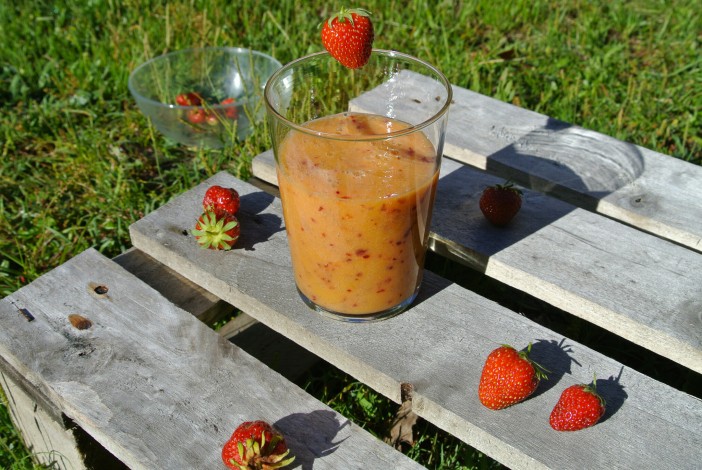
A few weeks ago when the sun was shining and temperatures soaring high up here, it seemed a perfect time to open ice cream making season and with strawberries available at every corner, what’s better than a refreshing berry sorbet?
However, once my sorbet was happily chilling in the freezer, the temperatures dropped. Seriously dropped. It feels like early freezing spring or mid autumn here now ( I’ve spent the last few days wrapped in sweaters with heaters fully on), and few prospects of seeing sunshine in the next days.
While this weather may not be ideal to enjoy refreshing treats, this sorbet turned out too good to resist, and although hot tea and sorbet pairing is slightly unconventional one, it works perfectly well for me here.
The sorbet is made out of strawberries with a touch of Creme de Cassis (black currant liquor) which adds complexity and richer berry flavor. Sweetened with a few spoonfuls of honey it’s light, delightful, and most likely the best berry sorbet I’ve made.
Once a sorbet basis is made, it’s easy to transform it to anything else, like cream cheese popsicles.
Simply stir in quark into the prepared sorbet mixture, divide between any molds you have, and after they’ve spent about 30 minutes in the freezer stick in a wooden spoon in each, and continue to freeze fully.
For a full ice cream cheese cake experience, you can make a simple almond crumble and even serve the popsicles dipped in it, making it a fun and easy way to serve ice cream. Happy coming weekend!
- 900 grams strawberries
- 2-3 tablespoons honey
- 5-8 tablespoons Crème de Cassis
- 500 grams quark if you want to make popsicles
- 50 grams almond flour
- 50 grams flour
- 50 grams sugar
- 50 grams butter
- pinch of salt
- Trim the strawberries and place them in food processor together with 2 tablespoons of honey and 5 tablespoons Crème de Cassis. Blend for 30 seconds – 1 minute, taste and add more honey or Crème de Cassis to your taste (I’ve added 8).
- If you prefer a sorbet without the strawberry seeds, then strain throw a fine sieve.
- Pour in a container and place in a freezer. Stir the sorbet well, once in an hour for the first 3 hours (otherwise you’ll end up with an ice cube).
- For popsicles stir in quark, divide between whatever moulds you have and freeze.
- To make the crumble heat the oven to 160C/320F.
- Line a tray with baking paper.
- Mix all the ingredients and rub with your fingers until you have crumbles. Place on a baking tray and bake for 8-12 minutes until golden brown.
- Leave to cool before dipping the popsicles.
I have big tingled smile writing this post, not because the topic is funny, but because I never thought I’ll be writing a how to section for photography; and had it not been for all the request received in the past month, I don’t think I’d be writing it now.
I’ve started this blog in 2010, but apart from occasional photographic mishaps (which were deemed tragic) I’ve never pointed a camera towards food (or anything else for the matter).
Instead I teamed up with a very dear friend and very talented photographer ieva, who took all food photos and polished them to the tea.
As you may know in life many good things can come to an end and as ieva got tangled up in her travels this winter and spring, there was no one to take beautiful photos of my culinary concoctions anymore.
I do have a Nikon D5000 with a standard 18-55mm lens, which beyond it’s automatic function I’ve never used before. So here I was in February 2013 reading my camera manual to understand how to use it, properly, and trying to wrap my head around all the fancy photography terms.
I should say, that I used to be the worst case in taking photos in the past. After a few photo taking moments back in 2010, ieva told me to never touch the camera again and when I called a family member at some point in February to joyfully announce, I’m now taking photos, there was a long silence at the other end of the line. The sort of silence you’d think I said I learned how to fly.
Believe me when I say, if I could do it, so can anyone. Photography isn’t rocket science of some sort (and at the end of the day it’s highly subjective) so everybody can learn it and do it.
With the next few posts, I’ll pin point the steps I’ve taken, found useful to take better photos. These tips aren’t limited to food, and you can apply them anywhere.
To start, a few words about our photo subject, the glorious food.
You can have the best photo equipment and experience behind you, but it’s very difficult to take a good photo of a poorly styled plate and even the most beautifully styled dish can look ugly, in wrong light and shoot from wrong angle.
It reminds me when a few years back we had a major photoshoot with 2 other photographers joining ieva and at one point a heated discussion erupted about the way my chicory gratin looked. It was deemed ugly, unphotogenic and I had to bring my chef’s knife with me to the discussion to get it photographed (who want’s to argue with a woman holding a big knife?).
I hope you get my point, food styling and photography skills are highly dependent on each other. I’ll cover food styling in the coming posts, but for now let’s start with the basics.
What is the difference between auto and manual functions?
The main difference is whether you take the decision on how your photo should look yourself or will you let your camera decide.
You may argue that nowadays cameras are fancy enough to take proper decisions, but camera “proper” may not be the one you want. Being able to adjust how much light will fall onto your photos can make a difference between a mediocre and great photo.
Below I have taken a photo set on manual and auto (set on a tripod in same light conditions).
See the difference?
The auto one is much darker, while in manual mode I was able to get more light into the photo, that is to increase exposure (note: these photos were taken in raw and have not had any editing)
Technically speaking, exposure refers to the amount of light your photography object is exposed to.
The holy trio of photography
Three items make up exposure: aperture, shutter speed and ISO. This is the point where for me it would get confusing almost ancient Sanskrit like language.
Aperture refers to the opening of the lens. If lens is wide opened a lot of light gets in, if lens is barely there little light gets in. Simple?
Aperture on your camera is marked as f/number it can range from f/1.4 to f/32.
The only confusing bit here is that f/1.4 is considered very large aperture meaning, lens wide opened and lots of light coming in, while f/32 mean small opening of lens and a streak of light only.
Aperture also determines the depth of field in your photo. The photo below was taken with Nikkor 50mm f/1.8 lens, aperture set on f/2.8, which allows to isolate the object, while the background is blurry.
The higher the aperture number, the more of background would be visible and sharp.
The photos below were taken with my Nikon 18-55mm lens set at f/5.6 and f/8.
Next you have shutter speed, which refers to how fast your lens opens/closes. For Nikon this is the number before the aperture. How does this affect the light?
The lower the shutter speed number, the more light it will let in and of course the higher the shutter speed the more light will come in.
Shutter speed is mainly used to capture motion, so for example if you’d like to capture running water in detail rather than just a stream, you’d need to set a high shutter speed. The same thing applies to moving object, the more movement the higher the shutter speed, other wise you’ll have a blurry photo.
Finally, you have ISO, which refers to how sensitive your camera is to light. ISO ranges from 100, 200, to 3200 and more. What does ISO mean for you when taking photos?
The lower the ISO, the less sensitive your light is to camera, while higher ISO numbers increase sensitivity to light. A high ISO number allows you to take photos in low light conditions, but a high ISO number comes at a price of photo quality. Usually from about ISO 400 and upwards the noise in your photo or the amount of grain increases, hence your photos will be of lower quality.
The standard ISO number to use is 100, but I usually use 200 as most of my photos are shot indoors, which is still ok, because you don’t see much difference in grain between 100 and 200.
To sum it up, aperture, shutter speed and ISO make up exposure, and by adjusting each you can how much light will be in your photo.
Practice is crucial here, but if you do not know where to start then set your ISO at 100 or 200, shutter speed at 1/125 and aperture at f/5.6 take a photo and adjust your settings then.
If the photo is too light, almost white, you will need to increase your shutter speed, while if it’s too dark you will have to lower the shutter speed.
If you are in a dark environment and even turning down shutter speed will not be enough you’ll have to increase your ISO.
Finally, if you want a great depth in the photo and to increase your aperture number from f/5.6 to f/8 or f/11 this, you’ll have to compensate the loss of light, by reducing shutter speed.
There is a light meter in your viewfinder which indicates whether your object is under/overexposed or just right (when it’s at zero). But that also depends on the mood you like to create, sometimes I prefer photos to be overexposed on purpose just to have them lighter.
The fourth leg
When taking photos apart from exposure settings (aperture, shutter speed and ISO) you also have to take into account white balance.
White balance basically refers to the temperature of your photo. See both photos in the first example above? One is slightly yellowing while the other has a cooler tone.
These are but two examples, on most cameras white balance can be set to: daylight, cloudy, shade, fluorescent, tungsten, flash, where each of the options can either cool or warm photos, depending where you are your needs.
You can also set your white balance to auto – this is where your camera chooses the most appropriate setting, per each shot you take. If you’re just starting using a digital camera this is the setting I’d recommend until you are fully comfortable with all the other parts.
I’ll be posting more tips on postproduction of photos as well as shooting in Jpeg versus Raw and food styling in the coming weeks.
For now, the best thing to do is to grab your camera and go to start practicing, then more practicing and even more practicing!
Happy Sunday everyone and for those who are celebrating Mother’s Day today may it be a splendid and spent with those you love.
We have celebrated Mother’s day last Sunday, what was the highlight of spring: sunny, warm and beyond lovely. But as in true Dutch weather fashion for one day of plentiful sunshine we have to pay with a week of pouring rain.
I hope it’ll be only one week for there is so long you can happily live with weather, which changes faster than one’s mood (I know as I could barely keep up changing camera setting to the popping up sun, darkening clouds, moody grey, pouring rain and all over again).
Last weekend we were all in the mood for light salads and ice cream, while this weekend it’s all about hearty casseroles and roasts (and killing tea supplies as if we were in midst November).
Had we not had a barely existent spring so far, I suppose there would be some charm in the ever changing weather, but I’m ready for a dose of sunshine.
While we are waiting (and here a wait can be long) it’s only appropriate to spice up a regular Sunday roast.
I’ve added garlic, chilli and plenty of ginger to chicken before placing in the oven and during the last minutes of roasting coated with thick honey soy, making overall taste intense enough that no previous marinating is needed. Paired with sticky carrots and fresh zucchini salad makes a complete Sunday lunch, but if you’re feeling particular hungry you can serve rice or rice noodles too. Enjoy!
- 1 whole free range chicken (about 1,5 kg)
- 2 heaped tablespoons of chopped ginger
- 1-3 red chilli peppers, chopped (depending how spicy you like it)
- 2 teaspoons palm sugar
- 4 tablespoons fish sauce
- 3 tablespoons soy sauce
- 1 lime juice
- 3 fat garlic cloves, chopped
- 200 ml water
- 800 grams carrots, peeled and sliced in half
- 3 tablespoons peanut oil (or any other vegetable oil)
- 3 garlic cloves, peel on and lightly crushed
- white sesame seeds for sprinkling
- ⅔ cup soy sauce
- 3 tablespoons honey
- 1 zucchini, finely sliced
- 1 tablespoon black sesame seeds
- fresh cilantro
- 1 tablespoon fish sauce
- ¼ teaspoon palm sugar
- 1 tablespoon lime juice
- Heat the oven to 190C/374F.
- Wash the chicken and pat dry, place in a roasting tin.
- To make the spice coating using mortar and pestle pound together ginger, chilli and garlic till you have nearly a paste.
- Stir in fish and soy sauces, lime juice and palm sugar.
- Pour over the chicken and rub all over with your hands to be sure it’s properly coated.
- Place in the oven and bake for 1 hour 5 – 1 hour 15 minutes, to check the whether it’s done, pierce the chicken with a knife, the juice should come out clear.
- About 10 -20 minutes into roasting pour the water in the tray, and at the same time mixing it with spices baste the chicken.
- Towards the end of roasting (15 minutes remaining) pour honey soy glazed on the chicken.
- Once the chicken is out of the oven, place the chicken upside down on a tray cover with plenty of foil and allow resting for at least 15 minutes. If the sauce is the pan is too thick you can add extra water to thin it out.
- For honey soy glaze, in a small saucepan bring soy and honey to boil and simmer till reduced by about a half.
- To prepare the carrots: in a large heavy bottomed pan, heat the oil and gently fry the carrots for 10 – 15 minute shaking and turning from time to time. Pour over 3-5 tablespoons of honey soy glaze (the remaining one is for the chicken) continue to cook till the liquid has almost evaporated.
- Finish with a sprinkle of white sesame seeds.
- For zucchini salad, mix together fish sauce, sugar and lime juice, taste and pour it over zucchini, sprinkle black sesame seeds on top and scatter some chopped cilantro.
- Serve roast chicken with glazed carrots and zucchini salad.
There are times time when the urge of sweetness is too overwhelming. When your eyes are frantically searching for something sweet to sink teeth in and daydreams of glorious sweets take over.
If during those desperate times you have a cookie hidden somewhere, I envy you, for nothing sweet in my household ever survives that long.
If you have though of the prospect of such hour and have equipped yourself with a treat to indulge in, I envy you even more.
At such hours, I usually find myself without a sweet thing in sight and even with ever present chocolate supplies gone. Fortunately, to satisfy the calling of sweet tooth there are many quick and easy delicacies to make, such as these light almond and coconut macaroons.
They take a few ingredients and a few more minutes of work and results can be savoured in a little over half an hour. They’re very delicate and slightly chewy and go excellent with any type of berries. I’ve used strawberries here which you can bake strawberries with the macaroons directly, or serve fresh for in between bites. Speaking of lightness, they require relatively little sugar, meaning they’re not too sweet and not at all naughty (and naturally gluten free). You can even serve them with a dollop of yogurt to richen up a bit!
These macaroons were made using a combination of coconut and almond flour, but they could be made with coconut flour only, though you’d need less coconut than almond flour (only ¼ cup), as coconut one is much more absorbent.
In case the concept of coconut flour is foreign to you it’s nothing but coconut flakes processed in a food processed very fine, so you can make them yourself.
One a final note, to answer the questions I’ve been getting in the email about the switching posting schedule. I admit it has been constantly shifting for the last few months, but now I’m always posting on Wednesdays, Fridays and Sundays, however, from 25th May, I’ll start a new project where I’ll be posting every day..!
Have a sunny weekend!
- 2 egg whites
- ⅓ cup/50grams sugar
- pinch of salt
- ½ cup/50 grams almond flour
- ⅔ cup/ 70 grams coconut flour
- 1 lemon zest, optional
- a handful of fresh strawberries
- Heat the oven 150C/
- Place egg whites, sugar and salt in a heatproof bowl over a pot of simmering water (do not let the bowl touch the water) and whisk till the egg whites will get just warm.
- Take of the heat and stir in almond, coconut flours and lemon zest if using.
- Place in the fridge for a couple of minutes to chill.
- If you are going to add strawberries, dice them into small pieces to mix in the dough or simply place the strawberries with the dough in a food processor and pulse 2-3 times.
- Line an oven tray with baking paper.
- Using a teaspoon scoop the dough, shape into a ball then flatten on the tray.
- Repeat with the rest. Bake for 15-20 minutes until golden brown. Let it cool for 5 minutes on a rack before serving (they will harden up).